The Dawn of Regenerative Privacy Infrastructure

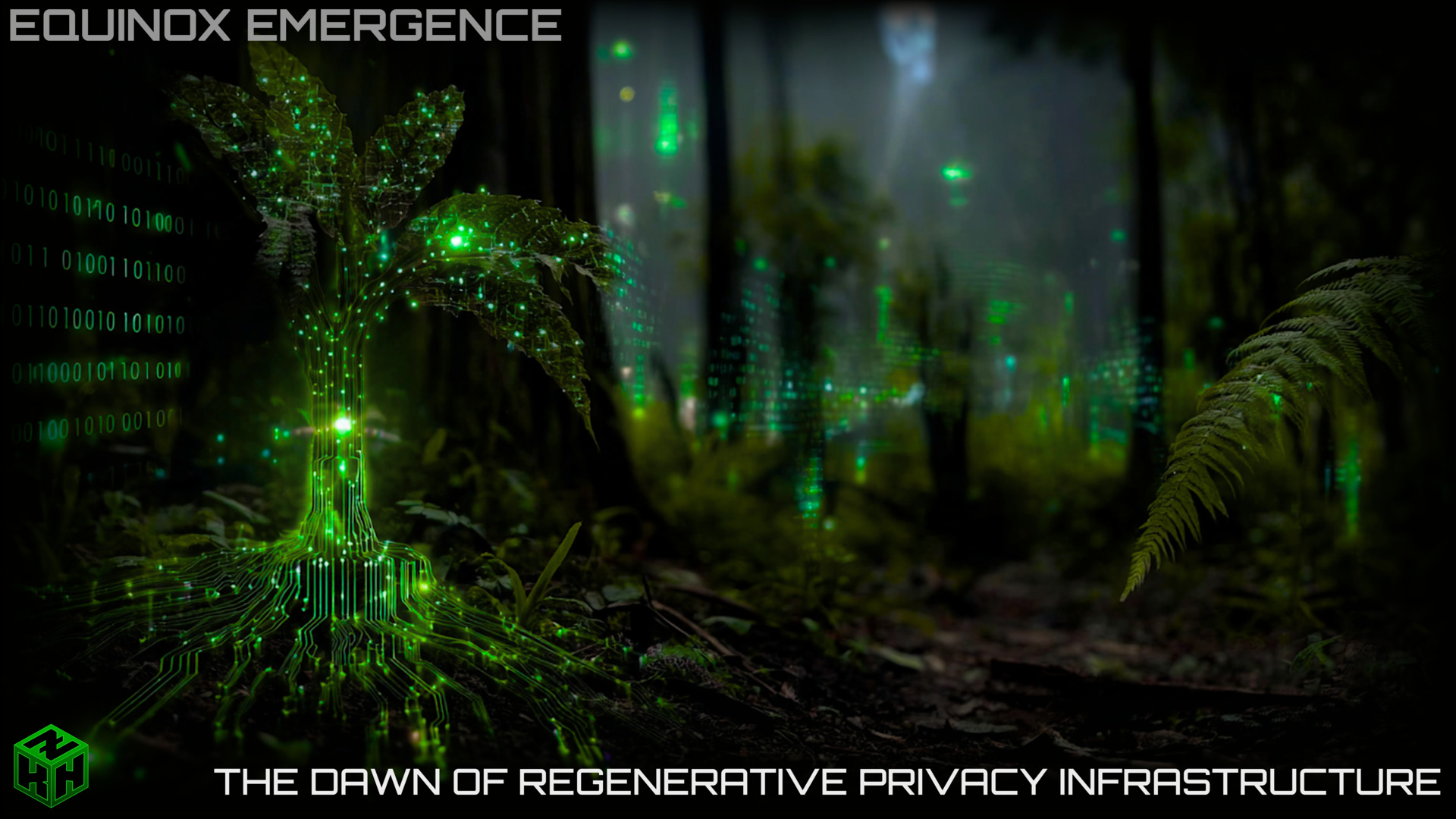
The equinox marks a threshold. Day and night hold equal weight, and something shifts: light begins to outpace darkness. In regenerative systems, these turning points matter. They are not arbitrary calendar dates but moments when accumulated energy finds its form and starts to move. What grew roots in the dark begins to reach for light.
For ZKNetwork, this spring equinox arrives with particular resonance. After seasons of deep research, iterative testnet deployments, hardware prototyping, and the careful composition of a privacy-first technology stack, the project emerges from the encrypted quiet of construction into visible expression. What follows is a clear-eyed snapshot of where ZKNetwork stands, what it has built, and where the architecture points next.
What ZKNetwork Is
ZKNetwork is a set of privacy-native infrastructure protocols combining decentralized privacy networks, zero-knowledge cryptography, and resilient edge hardware into a single coherent system. It functions as a Layer-0 coordination platform, serving as the substrate beneath applications, chains, and agents, enabling secure interactions between humans, machines, AI systems, and physical infrastructure.
The design philosophy is straightforward: privacy is not a premium feature bolted onto existing architecture. It is the architecture. Content encryption alone is insufficient when metadata, including who communicates with whom, when, how often, and from where, remains exposed. ZKNetwork protects the full surface: content, metadata, identity, and intent, from cloud to edge, without compromise.
This is infrastructure for the Intelligence Era. As AI agents proliferate, as autonomous systems coordinate at machine speed, as physical devices generate rivers of data at the edge, the question of who controls the coordination layer becomes existential. ZKNetwork's answer: no one owns it; everyone strengthens it. Privacy becomes the foundation of trust. Verification replaces assumption. And value regenerates through participation rather than extraction.
Dual-Layer Regenerative Infrastructure
In a forest, the most vital architecture is invisible. Fungal networks run beneath the soil for miles, routing nutrients, signaling threats, and connecting organisms that appear separate above ground into a single living system. The flowers bloom in sunlight, but they bloom because the mycelium moves in darkness.
ZKNetwork's architecture follows this pattern. Two interdependent infrastructure layers — one encrypted and hidden, the other visible and public-facing — form a complete system where private coordination beneath enables regenerative applications above.
☽ Lunar Layer — Privacy Infrastructure
The encrypted substrate: privacy-preserving protocols that route, verify, and coordinate beneath the surface, invisible to adversaries but alive with activity.
- Post-quantum mix network routing providing strong anonymity through traffic-analysis-resistant message relay with sender-receiver unlinkability and timing obfuscation
- Zero-knowledge trust systems enabling privacy-preserving authentication, credential verification, and data provenance without identity exposure
- Decentralized coordination infrastructure including zero-knowledge PKI for node identity and directory services, and application-layer orchestration atop the encrypted substrate
☉ Solar Layer — Applications & Physical Infrastructure
The visible expression: sovereign hardware, public-facing applications, and community coordination that people can see, use, and join.
- Energy-sovereign edge hardware with tamper-resistant, micro-grid compatible nodes operating independently of centralized power and communications infrastructure
- Privacy-first applications and developer SDKs built on expanding substrate primitives: transport, ephemeral storage, and privacy-preserving computation
- Community-owned DePIN infrastructure providing geographic distribution and physical resilience through decentralized node operation
- Open governance interfaces and ecosystem participation tools built on the coordination primitives beneath
Architecturally, the Lunar Layer is foundational. Mixnets anonymize communication patterns. Zero-knowledge proofs verify claims without exposing underlying data. Post-quantum cryptography ensures these guarantees endure beyond the current threat horizon. This is infrastructure designed to strengthen under adversarial pressure rather than collapse, antifragile by design.
The Solar Layer is what activates the substrate: applications people use, hardware communities own, coordination tools that demonstrate a regenerative alternative to extraction. Its openness is survivable because the encrypted layer beneath it is decentralized and resistant to capture. Together, the two layers form an adaptive architecture: under permissive conditions, applications flourish openly; under pressure, the encrypted substrate expands to shelter more of what matters.
The Path Forward
ZKNetwork's roadmap moves from validated research through network activation to enterprise and institutional adoption across a 24-month arc. Each phase builds deliberately on the last, expanding the surface of what's possible while deepening the privacy guarantees that make it trustworthy.
Phase 0 / Genesis Research & Validation: (Complete) Core research, six iterations of mixnet testnet deployment, ZKNetwork client development, edge hardware prototyping, academic technical paper, and the formation of a community of early technical enthusiasts.
Phase 1 / Network Activation: Decentralized mix network launch, WalletShield RPC privacy application, metadata-private browser extension, incentivized beta expansion, and B2C rollout.
Phase 2 / Developer Ecosystem & Trust Infrastructure: ZK trust registry, ZK-Firewall access control, metadata-private group chat, developer SDKs, DIY hardware kits, and B2B rollout initiating the enterprise channel.
Phase 3 / Enterprise Infrastructure: ZK verification services, provenance systems for supply chain integrity, secure edge hardware platform deployment, AI and agentic integration pathways, and enterprise-grade support contracts.
Phase 4 / Institutional Scale & Vertical Expansion: Secure AI at the edge, targeted verticals in energy, agriculture, healthcare, and municipal resilience, the Regenerative Coordination Framework as a composable governance protocol, and institutional adoption.
The Platform: Privacy Infrastructure for the Real World
ZKNetwork delivers privacy as infrastructure, not as a premium add-on. The platform comprises interconnected capability layers, each designed for independent adoption or seamless composition. Generally, verification and read access are free while writes, governance, and infrastructure services are paid.
Mix Network: The foundational privacy substrate. Messages route through multiple relay nodes with layered encryption and timing obfuscation, making communication patterns indistinguishable from noise. Powers WalletShield for blockchain interactions, metadata-private API routing, and SDK-enabled applications.
Metadata-Private Group Chat: Sender-receiver unlinkability with strong anonymity guarantees, serving individuals, communities, and sectors requiring communications that leave no exploitable trace including legal, healthcare, government, and beyond.
ZK Trust Registry (ZK-PKI): A privacy-preserving registry for cryptographic identifiers and attestations. Cryptographic identity is registered and managed, while downstream participants, auditors, and systems verify freely, anchoring trust without exposing sensitive associations.
ZK-Firewall: Privacy-preserving access control using zero-knowledge proofs instead of identity disclosure. Age verification without birthdates, residency checks without addresses, enterprise resource gating without exploitable access logs.
ZK Provenance Services (ZK-BOM): Verifiable supply-chain integrity for software and physical systems. Cryptographic roots for each bill of materials — recursively verified, updated, and governed using zero-knowledge proofs. Free to audit, paid to register and govern.
Secure Edge Hardware Platform: Tamper-resistant devices extending zero-knowledge guarantees into the physical world. Hardware-backed identity, provenance, higher-assurance proofs, and secure edge execution across IoT, DePIN, and regulated industries, amplifying every other utility without being a prerequisite for adoption.
Together, these layers form a self-reinforcing ecosystem: infrastructure adoption drives verification volume, hardware deepens trust assurance, and real-world utility sustains network growth. Each new participant widens the coordination surface and strengthens the privacy set, creating a regenerative cycle in which the whole exceeds the sum of its parts.
Regenerative Tokenomics
The ZKN token is the network's circulatory system as an operational primitive that aligns incentives, funds growth, and ensures that value regenerates through the ecosystem rather than leaking out of it. Protocol revenue flows through the Regenerative Tokenomics Router, distributing across four interlocking pools that create continuous feedback loops between revenue, supply dynamics, and ecosystem development.
ZKN Treasury: Protocol-owned demand through continuous ZKN acquisition and long-term locking. Revenue inflows convert to ZKN and lock, creating structural demand without dilution.
Yield Vault: Stablecoin rewards for network operators, stakers, and ecosystem contributors. Stable payouts decouple operator sustainability from token volatility.
Grants & ReFi Pool: Ecosystem growth funding with proof-of-commitment requirements. Grant recipients commit to re-staking and revenue recursion, ensuring funded projects feed the next cycle.
Liquidity Reserve: Market stability and protocol-owned liquidity provision. Reserves pair with ZKN to create deep, DAO-owned liquidity and risk coverage.
This is the Regenerative-DePIN Flywheel in practice: stablecoin revenue enters, splits across strategic pools, funds growth and operations, generates new utility, attracts new participants, and the cycle accelerates. Each loop strengthens the network technically (more nodes, better anonymity), economically (larger treasury, deeper liquidity), and socially (richer ecosystem, stronger community). Governance participation requires token locking, aligning voting power with long-term commitment. The result is Balanced Regenerative Equilibrium, where revenue flows in as energy while the token side absorbs and transforms it.
Strategic Positioning
ZKNetwork operates at the convergence of privacy networking, enterprise security, decentralized physical infrastructure (DePIN), and AI coordination systems. The regenerative infrastructure model creates a parallel network capable of independent operation while supporting emerging coordination paradigms in digital and physical systems.
In the Intelligence Era, where AI agents coordinate autonomously, where synthetic media erodes trust, and where physical and digital systems converge at the edge, the next generation of regenerative digital infrastructure will be defined by privacy and verification embedded in the foundation.
This is the foundation. The substrate is live, the layers are composing, and the builder surface is expanding. Future articles will unpack how these utility layers interoperate, what primitives they expose, and what capabilities they unlock for builders constructing privacy-native applications on regenerative infrastructure. Stay tuned.